 Estrelu
The 3-day rule for starting solids: how long to wait between new foods
The 3-day rule means you offer one new food, then watch your baby for about three days before adding the next one. It is a way to tell which food caused a reaction. Here is what the AAP, NHS and other health bodies actually say, when waiting is useful, and how to keep a simple food log.
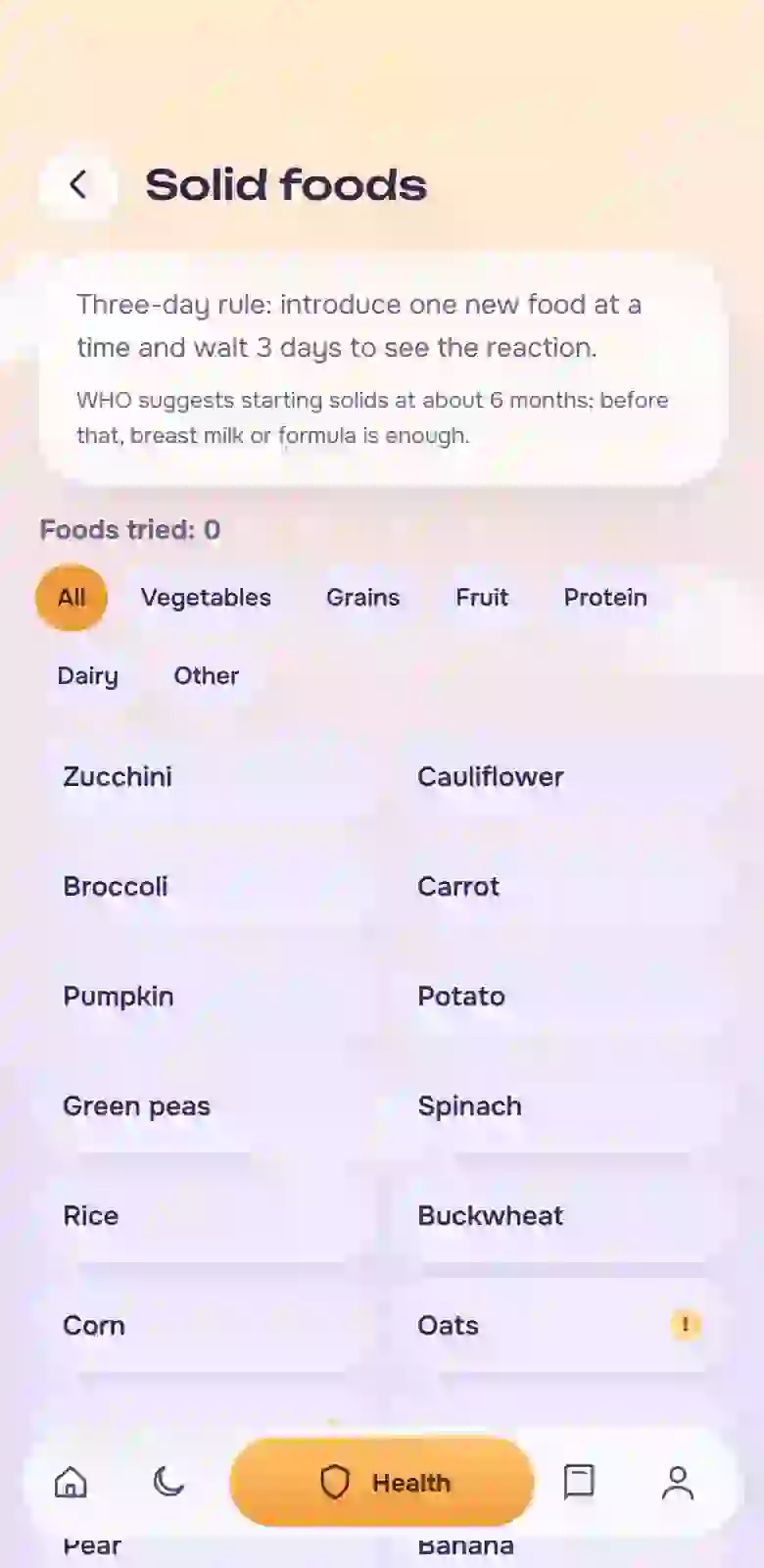
Where the 3-day rule comes from
The idea is simple: if you add foods one at a time, a reaction is easier to trace. The American Academy of Pediatrics puts it this way: introduce one single-ingredient new food from any food group every 3 to 5 days and look out for any reactions (AAP HealthyChildren).
So "3 days" is the short end of the AAP range, not a fixed medical law. Other guidelines focus only on allergens, and some set no interval at all. We could not find a single original source for the exact number three.
What the AAP says
The AAP recommends breast milk only for about the first 6 months (AAP HealthyChildren). When you start solids, it suggests looking for signs of readiness, such as good head control and opening the mouth when food comes near.
For pacing, the AAP gives the 3-to-5-day window for each new single-ingredient food. It also says there is no evidence that waiting beyond 4 to 6 months to introduce soft, baby-safe forms of eggs, dairy, soy, peanut products or fish prevents food allergy. Testing for peanut allergy is recommended for babies with severe eczema and/or egg allergy (AAP HealthyChildren).
New foods can be introduced every three to five days to give enough time for delayed reactions to be recognized.
What the NHS says
The NHS does not set a fixed number of days for every food. It focuses on allergens. Foods such as peanuts, hens' eggs, gluten and fish can be introduced from around 6 months, one at a time and in small amounts, so you can spot any reaction (NHS).
The NHS also says that once these foods are introduced and tolerated, they should become part of your baby's usual diet to reduce the risk of allergy (NHS). In other words, the goal is not to introduce a food once and then drop it.
What WHO, ESPGHAN and others say
Looking wider helps explain why advice online seems to clash.
| Source | What it says about spacing new foods |
|---|---|
| WHO (2023) | Complementary feeding for ages 6–23 months with a focus on a varied diet; we found no fixed waiting period (WHO) |
| ESPGHAN (2017) | Start solids not before 4 months (17 weeks) and not later than 6 months; allergenic foods may be introduced any time after 4 months; no fixed interval (ESPGHAN) |
| SBP, Brazil (2024) | Egg, fish and peanut can be introduced from 6 months; no required interval between new foods (SBP) |
They all agree on one thing: a new food, especially an allergen, should be offered in a way that lets you link any reaction to it. Where they differ is whether a fixed pause is needed.
When waiting 3 days makes sense
A pause is most useful when you want a clear "food → reaction" link.
- First taste of a common allergen. Egg, peanut, fish, wheat, dairy. The NHS notes that reactions usually happen within minutes but may take up to 2 hours, and up to 3 days with cow's milk (NHS).
- Your baby has eczema or a known food allergy. The NHS advises extra care for these babies and for families with a history of food allergies, eczema, asthma or hay fever (NHS). Make a plan with your pediatrician first.
- It helps you stay calm. A steady rhythm can make the first weeks less confusing.
When you don't need to wait
Foods your baby already eats don't reset the clock. Oatmeal they have had all week or squash from last Tuesday can sit alongside a new food.
A strict pause can also slow down variety. Brazilian pediatricians stress that there is no strict order for first foods and that families can plan the process with their pediatrician (SBP, 2024).
Rough days are a special case. During a cold, after vaccines or while teething, rashes and loose stools can have many causes. Many parents stick to familiar foods on those days and save new ones for later.
A two-week example
Say your baby already eats squash and you want to add cauliflower, egg yolk and pumpkin. These foods are only an example, not a plan. Your pediatrician can help you decide what fits your baby.
With the 3-day rule. Monday: cauliflower. Tuesday to Thursday: keep offering it next to squash and watch. Friday: egg yolk, then three more days of watching. Pumpkin comes the following Tuesday. You add three or four foods in two weeks and always know which one to look at.
Without a fixed pause. New foods come faster, but allergens still go in one at a time, on a day with nothing else new. This is closer to how the NHS frames it.
Either way, offer new foods earlier in the day. If something shows up, you will see it in daylight, not at 2 a.m.
It's typically recommended to start with peanut butter that's been diluted with either breast milk, formula or water.
How to keep a food log
A log saves you from guessing a week later. Write down four things:
- Food and form. "Broccoli, puree" or "egg, well-cooked yolk."
- Time and rough amount. "12:30, a few spoons."
- Allergen or not. So you know which allergens are already in.
- What you noticed. Rash, redness around the mouth, vomiting, loose stools, fussiness. If nothing, write "no reaction."
It helps when meals sit on the same timeline as sleep and diapers. Sometimes a "reaction" turns out to match a bad night or a new tooth.
How Estrelu handles it
In the Estrelu solids tracker, the 3-day rule is an option. Turn it on and the app reminds you that a new food is followed by three days of watching. Turn it off and you still log foods and reactions.
Allergens are flagged, reactions are recorded, and you can see which food lines up with which reaction. If your baby is sick, mark it as an "Off day." Before an appointment, the doctor visit summary pulls together 7, 14 or 30 days of logs that you can show on screen, print or send as text.
When to call your doctor
Talk to your pediatrician before starting solids if your baby has eczema, a known food allergy, or a family history of food allergies, asthma or hay fever.
Call your pediatrician if you see a rash, itching, swelling, vomiting, diarrhea or worse eczema after a new food (NHS). Bring your log: what your baby ate, when, and what you saw.
Call 911 (or your local emergency number) right away if your baby has trouble breathing or is breathing very fast, wheezing, swelling of the tongue or throat, a rash, or becomes floppy, limp or pale. The NHS describes anaphylaxis as a medical emergency that needs urgent treatment (NHS, NHS: Anaphylaxis).
Estrelu is not a medical device. It does not diagnose, calculate doses or replace advice from your doctor. This page is for general information only.
Frequently asked questions
- Do I have to wait exactly 3 days between new foods?
- No single interval is required everywhere. The AAP suggests one new single-ingredient food every 3 to 5 days, the NHS asks you to introduce allergenic foods one at a time, and the Brazilian Society of Pediatrics sets no fixed interval. Ask your pediatrician what pace suits your baby.
- How soon does a food allergy reaction show up?
- According to the NHS, reactions usually happen within a few minutes, but symptoms can take up to 2 hours to appear. With cow's milk, symptoms can take up to 3 days.
- Can I give foods my baby already eats during the 3 days?
- Yes. The waiting period is only about the new food. Foods your baby already eats without problems can stay on the menu, which also keeps meals varied.
- Can I turn off the 3-day rule in Estrelu?
- Yes. In Estrelu the 3-day rule is optional. With it off, you still log foods, flag allergens, record reactions and see which food lines up with which reaction.
Sources
- AAP HealthyChildren. Starting Solid Foods healthychildren.org
- NHS. Baby's first solid foods nhs.uk
- NHS. Food allergies in babies and young children nhs.uk
- NHS. Anaphylaxis nhs.uk
- WHO Guideline for complementary feeding of infants and young children 6–23 months (2023) who.int
- ESPGHAN 2017. Complementary Feeding: A Position Paper espghan.org
- SBP 2024. Alimentação complementar para o lactente saudável sbp.com.br
- Children's Wisconsin. Introducing solids and the fear of allergies childrenswi.org
- Texas Children's. Introducing peanut butter to infants texaschildrens.org
Try Estrelu
Five days free, no card asked.
Read next
- Starting Solids Tracker with the 3-Day RuleTrack first foods, flag allergens and log reactions with an optional 3-day rule, so you see which food came before a reaction. Offline, in your browser.
- Baby Log for Pediatrician VisitsTurn 7, 14 or 30 days of feeds, sleep and diapers into a pediatrician summary, plus your question list and appointment reminders. Offline, in your browser.
- Baby Feeding Tracker: Log Breast, Bottle and Diapers in One TapLog breast, bottle and diapers in one tap with Estrelu, a baby feeding tracker that runs in your browser, works offline and supports oz. No app store, no ads.
- Leap and Teething Tracker for Fussy WeeksMark teething, illness, leaps and shots as off days so the sleep forecast stays honest, and see when a fussy week may come. Works offline in your browser.