 Estrelu
Wake window calculator
A wake window is the time between your baby waking up and their next sleep. This calculator takes your baby's age and the time they woke up, then shows a range for when to start winding down for the next nap. It's a practical guide for parents of babies and toddlers up to age three, not a medical rule.
What you enter isn't sent anywhere and isn't saved.
How to use the calculator
- Enter the date of birth. The calculator works out the age in months and picks the right row.
- Enter the wake-up time. That's when your baby woke up from the night or from the last nap.
- Check the range. The start of the range is when you can begin winding down: dim the lights, switch to quiet play. The end is the point after which settling often gets harder.
If your baby is clearly tired before the range starts, put them down earlier. Sleepy cues beat the clock.
Wake windows by age
These numbers are the starting points used in Estrelu's sleep forecast. Your baby's window may be shorter or longer, and that's fine.
| Age | Wake window |
|---|---|
| under 1 month | 40–70 min |
| 1 month | 55–85 min |
| 2 months | 1 h 05 min – 1 h 40 min |
| 3 months | 1 h 15 min – 1 h 55 min |
| 4–5 months | 1 h 30 min – 2 h 15 min |
| 6–8 months | 2 h – 2 h 45 min |
| 9–11 months | 2 h 30 min – 3 h 15 min |
| 12–14 months | 3 h – 3 h 45 min |
| 15–17 months | 4 h – 4 h 45 min |
| 18–23 months | 5 h – 5 h 45 min |
| 2–3 years | 4 h 30 min – 5 h 30 min |
Many parents notice the first window of the morning is shorter and the last one before bedtime is longer. Watch your baby: yawning, eye rubbing and staring off often tell you more than the clock.
Where these numbers come from
There is no official standard for wake windows. We found no chart of how many minutes a baby should stay awake in WHO, AAP or AASM materials. Wake windows are a practical tool that grew out of the experience of parents and sleep consultants.
The official science gives a different anchor: total sleep per day. The American Academy of Sleep Medicine recommends (AASM, 2016):
- 4 to 12 months: 12 to 16 hours per 24 hours, including naps;
- 1 to 2 years: 11 to 14 hours;
- 3 to 5 years: 10 to 13 hours.
The AASM makes no recommendation for babies under 4 months, because sleep varies so much at that age. The American Academy of Pediatrics notes that newborns sleep about 16 to 17 hours a day (AAP HealthyChildren).
Estrelu's wake window chart is our practical starting point, not a standard and not a calculation from these recommendations.
When the chart won't fit
Off days. Illness, vaccines, teething, a developmental leap or travel can make your baby tire faster or fight sleep. Don't chase the window at all costs.
Dropping a nap. When your baby goes from three naps to two, or two to one, windows jump and for a while no number fits. See our guide to the 2 to 1 nap transition.
Premature babies. Count age from the due date, not the birth date. Ask your pediatrician how long to use adjusted age.
Short naps. After a short nap, babies often get tired sooner than after a long one.
How to make the forecast personal
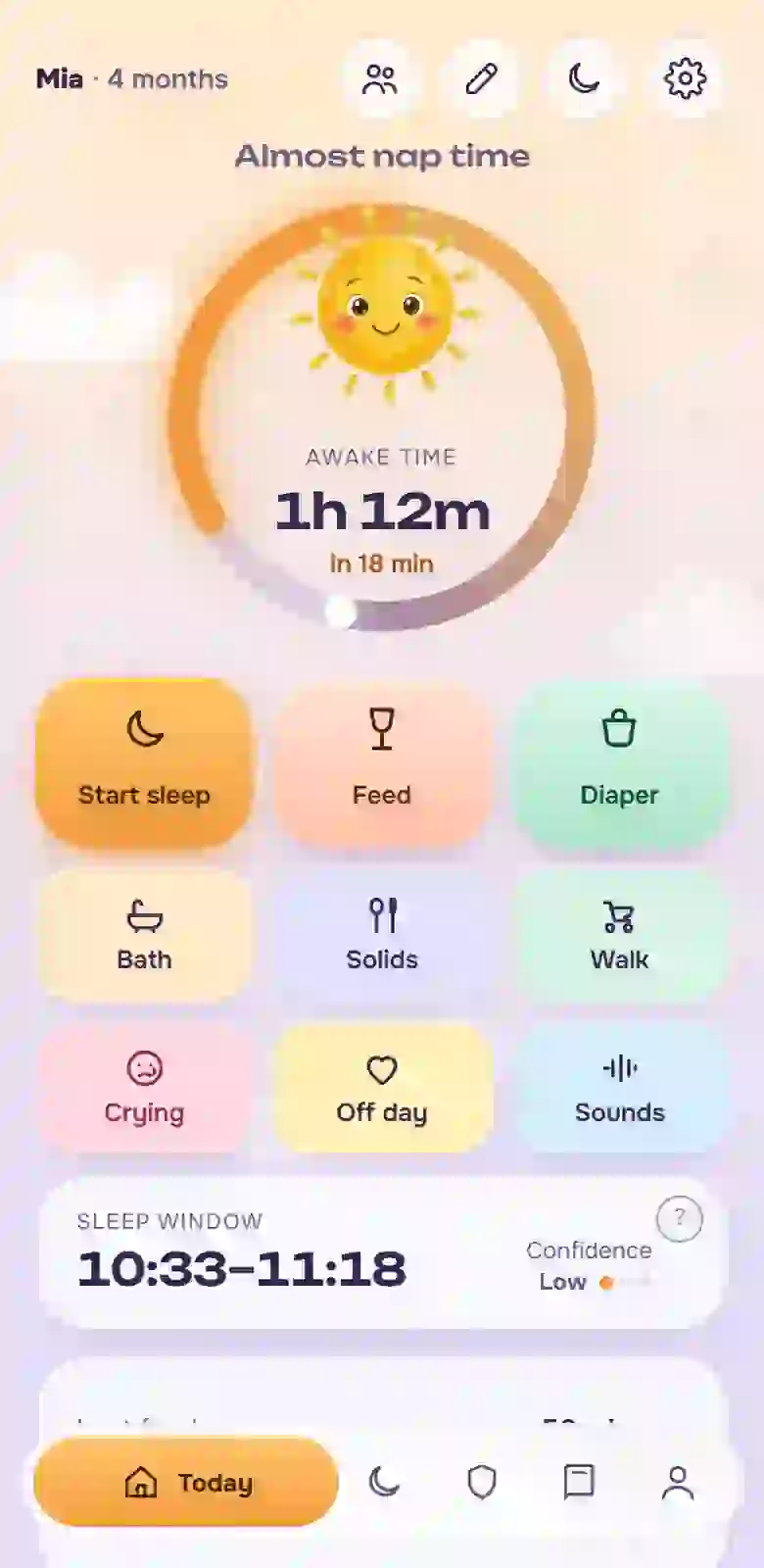
The chart is the same for everyone, but your baby isn't. Estrelu starts with age-based guides, then adapts to your baby's own logs after a few days.
The next nap shows as a range with a confidence level: low, medium or high. Tap it to see what the estimate is based on. You can get a notification 15 minutes before the window and when it opens. If your baby is sick, mark an "Off day": the forecast won't learn from it and shows a wider range.
Learn more on the sleep tracker page. Flying soon or facing a clock change? Try the time change planner.
If you're not sure, maybe the list of wake window intervals is useful to you, feel free to try it out. But don't worry if it doesn't work for your child.
When to call your doctor
Talk to your pediatrician if your baby is very sleepy and hard to wake for feeds, barely sleeps and is unsettled most of the time, snores or pauses in breathing during sleep, or if sleep changes suddenly along with fever, refusing feeds or other signs of illness.
Estrelu is not a medical device. It does not diagnose, calculate doses or replace advice from your doctor. This calculator is for general information only.
Frequently asked questions
- What is a wake window?
- It's the stretch of time between when your baby wakes up and their next sleep. Putting your baby down within it often makes falling asleep easier. Wake windows are a practical guide; there is no official medical standard for them.
- How much sleep does my baby need?
- The American Academy of Sleep Medicine (2016) recommends 12 to 16 hours per 24 hours for babies 4 to 12 months, 11 to 14 hours for ages 1 to 2, and 10 to 13 hours for ages 3 to 5, including naps. It makes no recommendation for babies under 4 months.
- How do I use wake windows for a premature baby?
- Parents usually go by adjusted age, counting from the due date rather than the birth date. Ask your pediatrician how long to keep using adjusted age.
- Why does the calculator show a range instead of an exact time?
- Babies differ, and the same baby gets tired at different times on different days. A range is more honest than an exact minute. In Estrelu, the forecast adapts to your baby's own logs after a few days.
Sources
- AASM 2016. Recommended amount of sleep for pediatric populations jcsm.aasm.org
- AAP HealthyChildren. Getting Your Baby to Sleep healthychildren.org
- Craig Canapari MD. Do Wake Windows Help Babies and Kids Nap Better? drcraigcanapari.com
Try Estrelu
Five days free, no card asked.
Read next
- Baby Sleep Tracker App with Nap PredictionEstrelu predicts your baby's next nap as a time range with a confidence level and plans today and tomorrow. Works offline in your browser, no app store, no ads.
- The 2 to 1 nap transition: signs, timing and a 2-week planWhen do toddlers drop from two naps to one? Signs your child is ready, a gentle two-week plan, what to do about bedtime, and when to talk to your pediatrician.
- Baby jet lag and time change plannerPlan your baby's sleep around a flight or a clock change. Shift naps and bedtime 10–15 minutes a day, use daylight well and know when to call your pediatrician.
- Leap and Teething Tracker for Fussy WeeksMark teething, illness, leaps and shots as off days so the sleep forecast stays honest, and see when a fussy week may come. Works offline in your browser.