 Estrelu
Sources and How We Check Our Content
This page lists every source behind Estrelu and the content on this site, plus the rules we follow when we check them. It's for parents, clinicians and anyone who wants to know where the numbers in the app come from. In short: every number has a link, we open every source ourselves, and we never give doses or diagnoses.
Which sources we use
We rely on international and national health organizations. Below is exactly what we took from each one. All links were opened and checked on October 4, 2026.
Sleep
- AASM 2016: the American Academy of Sleep Medicine's recommended sleep totals, naps included. 12–16 hours a day for 4–12 months, 11–14 hours for 1–2 years, 10–13 hours for 3–5 years. The paper makes no recommendation for babies under 4 months.
- AAP: Getting Your Baby to Sleep: newborns sleep about 16–17 hours a day.
- AAP: Safe Sleep: the safe sleep guidance we point to in our sleep content.
Feeding and diapers
- CDC: in the first weeks and months, breastfed babies usually feed about 8–12 times in 24 hours.
- NHS: Is my baby getting enough milk?: from day 5, breastfed babies have at least 6 heavy wet diapers a day.
- NHS: Colic: colic described as crying more than 3 hours a day, 3 days a week, for at least a week; it usually stops by 3 to 4 months.
- HSE (Ireland): wet and dirty diapers day by day in the first week for breastfed babies.
Starting solids
- WHO guideline, 2023: complementary feeding for babies 6–23 months.
- AAP: Starting Solid Foods: introduce one new single-ingredient food every 3–5 days. This is the basis of the optional 3-day rule in Estrelu.
- NHS: Baby's first solid foods: start around 6 months; offer allergens one at a time, in small amounts.
- ESPGHAN 2017: solids not before 4 months and not later than 6 months.
Guidance from different countries sometimes differs. When it does, we show both positions and suggest you talk it through with your pediatrician.
Growth
- WHO Child Growth Standards: the tables Estrelu uses to draw its curves.
- CDC: WHO growth charts: WHO charts to download; the CDC and the AAP recommend them for US babies from birth to 2 years (CDC).
When to call the doctor
- AAP: Fever — when to call the pediatrician and NHS: Fever in children: a temperature of 100.4°F (38°C) or higher in a baby under 3 months needs a call to the doctor right away; emergency warning signs.
- NHS: Anaphylaxis and NHS: Food allergies in babies: signs of an allergic reaction and anaphylaxis.
- NHS: Dehydration: signs of dehydration in babies.
- Poison Control (US): 1-800-222-1222.
How the nap forecast works
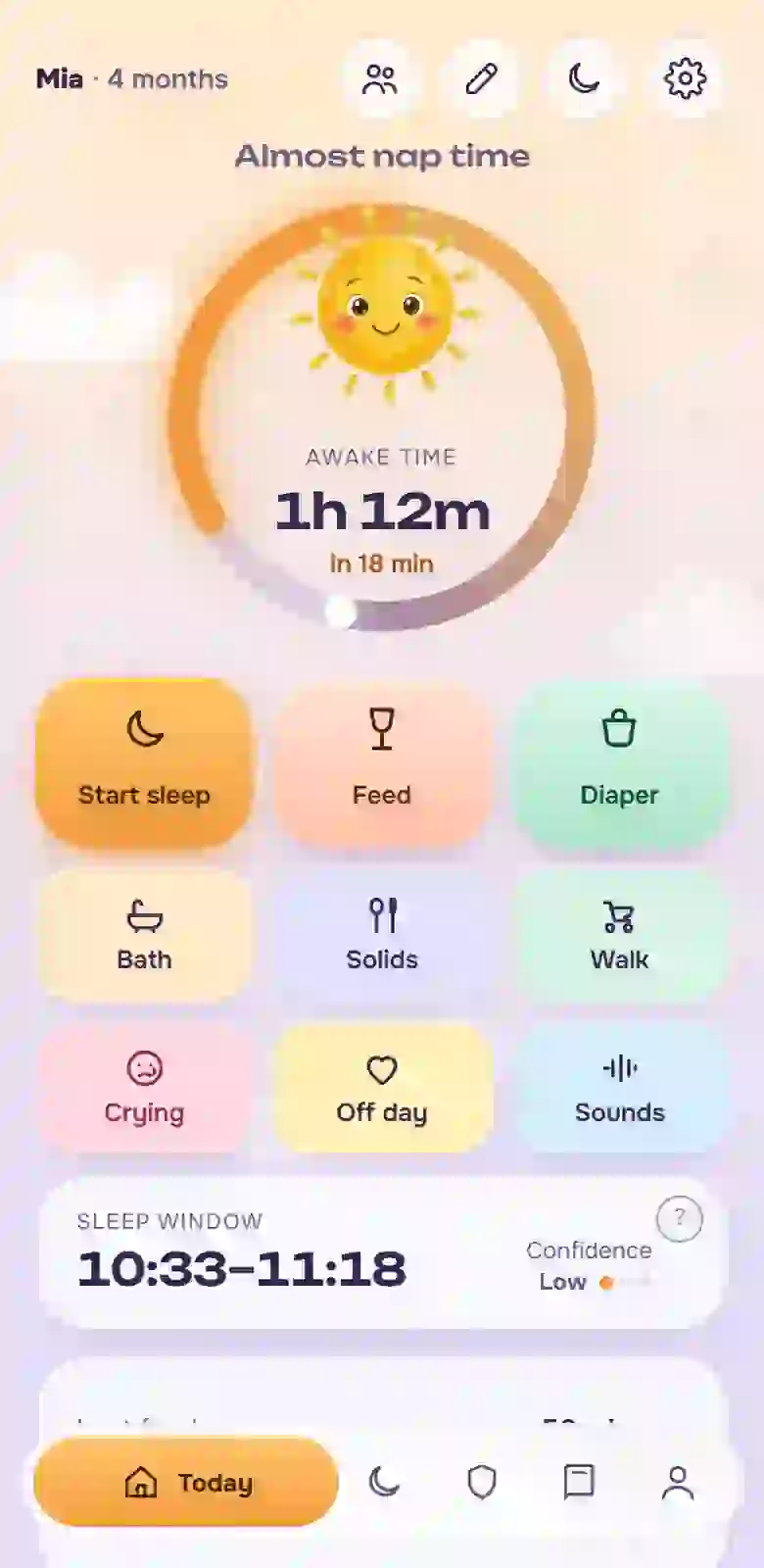
Estrelu builds its next-nap forecast in two steps. It's a guide, not medical advice.
Step 1: wake windows by age. While there are few logs, the app starts from a typical wake window for your baby's age. For example: 40–70 minutes under 1 month, 2 h to 2 h 45 at 6–8 months, 3 h to 3 h 45 at 12–14 months. These are Estrelu's forecast settings, picked as a starting point, not a norm. See every age range in the wake window calculator.
Step 2: adjusting to your logs. After a few days, the forecast leans on your baby's own naps. That's why it shows a range and a confidence level: low, medium or high. Tap the forecast and the app explains what went into it.
Off days are left out. When you mark an off day (illness, teething, a growth spurt, a vaccine), the forecast doesn't learn from it and shows a wider range. The mark ends by itself after 14 days.
Growth curves: WHO 2006
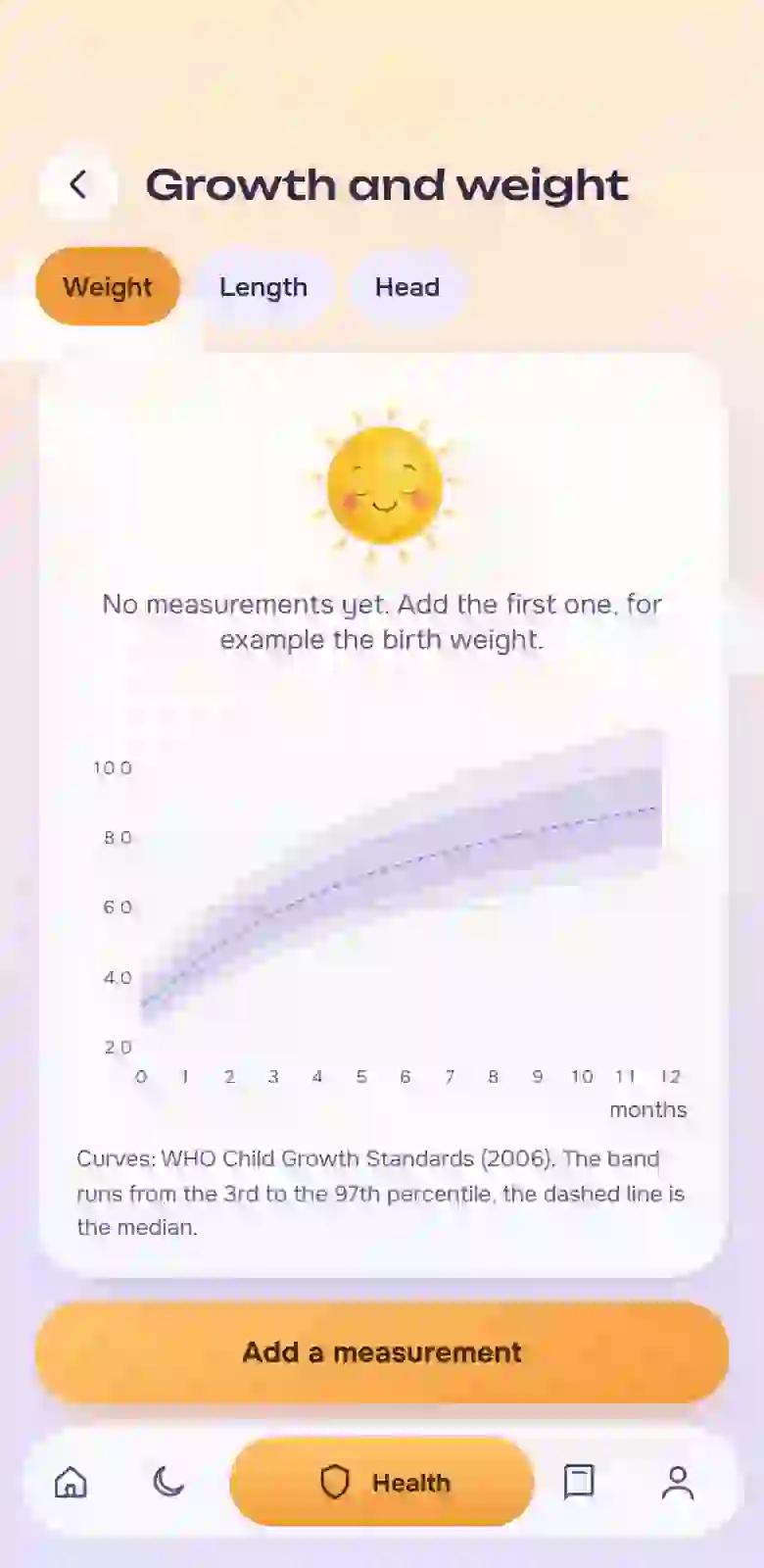
Estrelu's height and weight charts follow the WHO Child Growth Standards from 2006. The chart shows a reference band from the 3rd to the 97th percentile and a dotted median line. We don't color dots red or label them "good" or "bad." What a point means for your baby is your doctor's call.
Our content rules
- Every number has a source. We don't publish a number without a link. The source is on the list above, or one we opened ourselves and confirmed.
- Review dates. Every page shows when it was published and last updated. We recheck sources with each update.
- No doses, no diagnoses. We don't tell you how much medicine to give or whether something is "normal." Health pages include a "When to call the doctor" section.
- Real expert quotes only. We use a quote only if we can link to where it was published.
- Careful wording. We say "usually" and "according to the WHO," and we avoid sweeping promises.
The website should clearly indicate who develops and updates their content, as well as provide a means for contacting them.
How to report a mistake
If you see an error, an outdated number or a broken link, email support@nidalumi.com. Tell us the page address, what you think is wrong and, if you have one, a link to a source. We'll check it and update the page, and the new date will show at the top.
More about the project: About Estrelu.
Other sources our pages cite
- CDC Yellow Book 2026. Jet Lag Disorder
- HSE (Ireland). Naps for babies and toddlers
- Nationwide Children's Hospital. Helping Kids Adjust to the Time Change (2025)
- Nemours KidsHealth. Naps
- SBP 2024. Alimentação complementar para o lactente saudável
- Sydney Children's Hospitals Network. Sleep recommendations for toddlers (1–3 years)
Estrelu is not a medical device. It doesn't diagnose, doesn't calculate medicine doses and doesn't replace advice from your doctor.
Frequently asked questions
- Is the Estrelu nap forecast medical advice?
- No. It's a guide. It starts from typical wake windows for your baby's age and then adjusts to your own logs. The decisions stay with you and your doctor.
- Why WHO growth charts?
- The CDC recommends the WHO 2006 standards for children under 2 in the US, and many other countries use them too. That keeps the curves consistent across all four languages of Estrelu.
- I found a mistake. Where do I report it?
- Email support@nidalumi.com with the page address and what you think is wrong. If you have a link to a source, include it.
Sources
- AASM 2016: Recommended amount of sleep for pediatric populations jcsm.aasm.org
- WHO: Child growth standards who.int
- WHO: Guideline for complementary feeding of infants and young children 6–23 months (2023) who.int
- AAP HealthyChildren: Starting Solid Foods healthychildren.org
- AAP HealthyChildren: Safe Sleep healthychildren.org
- AAP HealthyChildren: Getting Your Baby to Sleep healthychildren.org
- NHS: Baby's first solid foods nhs.uk
- NHS: Colic nhs.uk
- NHS: Is my baby getting enough milk? nhs.uk
- CDC: How much and how often to breastfeed cdc.gov
- CDC: WHO growth charts cdc.gov
- HSE: Is your baby getting enough breast milk www2.hse.ie
- CDC: Summary — Using WHO Child Growth Standards cdc.gov
- AAP HealthyChildren: Fever and Your Baby — When to Call the Pediatrician healthychildren.org
- NHS: High temperature (fever) in children nhs.uk
- NHS: Anaphylaxis nhs.uk
- NHS: Food allergies in babies and young children nhs.uk
- NHS: Dehydration nhs.uk
- Poison Control (US) poison.org
- ESPGHAN 2017: Complementary Feeding position paper espghan.org
- Nationwide Children's Hospital: How to Navigate the Internet for Health Information nationwidechildrens.org
Try Estrelu
Five days free, no card asked.
Read next
- About EstreluWho builds Estrelu, the baby sleep and feeding tracker, and why. No ads, no red numbers, your data stays yours. Plus how we research and check every page.
- Baby Sleep Tracker App with Nap PredictionEstrelu predicts your baby's next nap as a time range with a confidence level and plans today and tomorrow. Works offline in your browser, no app store, no ads.
- Baby Growth Tracker with WHO Growth ChartsPlot your baby's weight and length on WHO 2006 growth standard curves, with a 3rd to 97th percentile band and no red alarms or labels. Offline, in your browser.
- Wake window calculatorEnter your baby's birth date and wake-up time to see when the next nap may fit. Plus a wake window chart by age, newborn to 3, and where the numbers come from.