 Estrelu
WHO growth percentile calculator for babies and toddlers
This calculator shows which percentile your baby's length (or height), weight and head circumference fall on, using the WHO child growth standards. A percentile is a place among children of the same age and sex. It is not a grade. The calculator is for parents of children under 5 who want to make sense of the numbers from a checkup.
What you enter isn't sent anywhere and isn't saved.
What is a percentile?
A percentile tells you what share of children of the same age and sex in the reference sample have a smaller value than your child. For example, length on the 40th percentile means about 40% of peers are shorter and about 60% are taller.
The 50th percentile is the median, the middle of the sample. It is not a target. Children on the 15th and the 85th percentile can be equally healthy; they are simply built differently.
Where the WHO curves come from
The calculator uses the 2006 WHO child growth standards. They are based on the WHO Multicentre Growth Reference Study (WHO), which included children from six countries: Brazil, Ghana, India, Norway, Oman and the USA (WHO).
WHO describes these standards as showing how children from birth to 5 years should grow under optimal conditions, in any country. The breastfed baby is the reference model (WHO).
The standards include length/height-for-age, weight-for-age, weight-for-length, body mass index and head circumference (WHO). In the US, the CDC and the AAP recommend the WHO growth charts for children from birth to 2 years (CDC), and the CDC publishes them for download (CDC).
WHO charts in the UK
In the UK, children under 4 are plotted on the UK-WHO growth charts, which are based on the WHO Child Growth Standards (RCPCH). That is the same standard this calculator uses, so the percentile you see here should sit close to the line your health visitor draws. If the two differ slightly, go by the chart in your baby's record and ask at the next check.
Why the curve matters more than one point
One measurement is a snapshot; growth is a movie. A single point can jump because of a wet diaper, a crying baby on the scale or a different measuring board. That is why one point is rarely judged on its own.
The NHS puts it this way: babies don't always grow along exactly one line. Measurements can move up or down by one percentile line, and crossing two lines is less common. If that happens, the NHS suggests talking to your health visitor (NHS).
Another example from the NHS: babies usually lose a little weight in the first days after birth, and most are back to their birth weight or above it by 3 weeks (NHS). Looking only at day 5, it is easy to worry for nothing.
How often to weigh your baby
Frequent weighing shows random ups and downs, not growth. The NHS (UK) suggests that after the first 2 weeks babies are weighed (NHS):
| Age | How often |
|---|---|
| Up to 6 months | No more than once a month |
| 6–12 months | No more than once every 2 months |
| Over 1 year | No more than once every 3 months |
Your pediatrician may suggest a different schedule. Numbers from checkups are the easiest to compare, because they come from the same scale and measuring board.
How to measure more accurately
The calculator works with exactly what you enter, so the measurement matters:
- Use numbers from checkups. They come from the same scale and board each time.
- At home, weigh the same way. Same time of day, no clothes or the same clothes, ideally before a feed.
- Babies are usually measured lying down (length) and older children standing (height). The WHO standard is called "length/height-for-age" for this reason (WHO).
- Enter the measurement date, not today's date. For a young baby, a week's difference in age noticeably changes the percentile.
- For babies born early, ask your pediatrician which date to count age from.
How to read the result
The result is a percentile and a point on the chart:
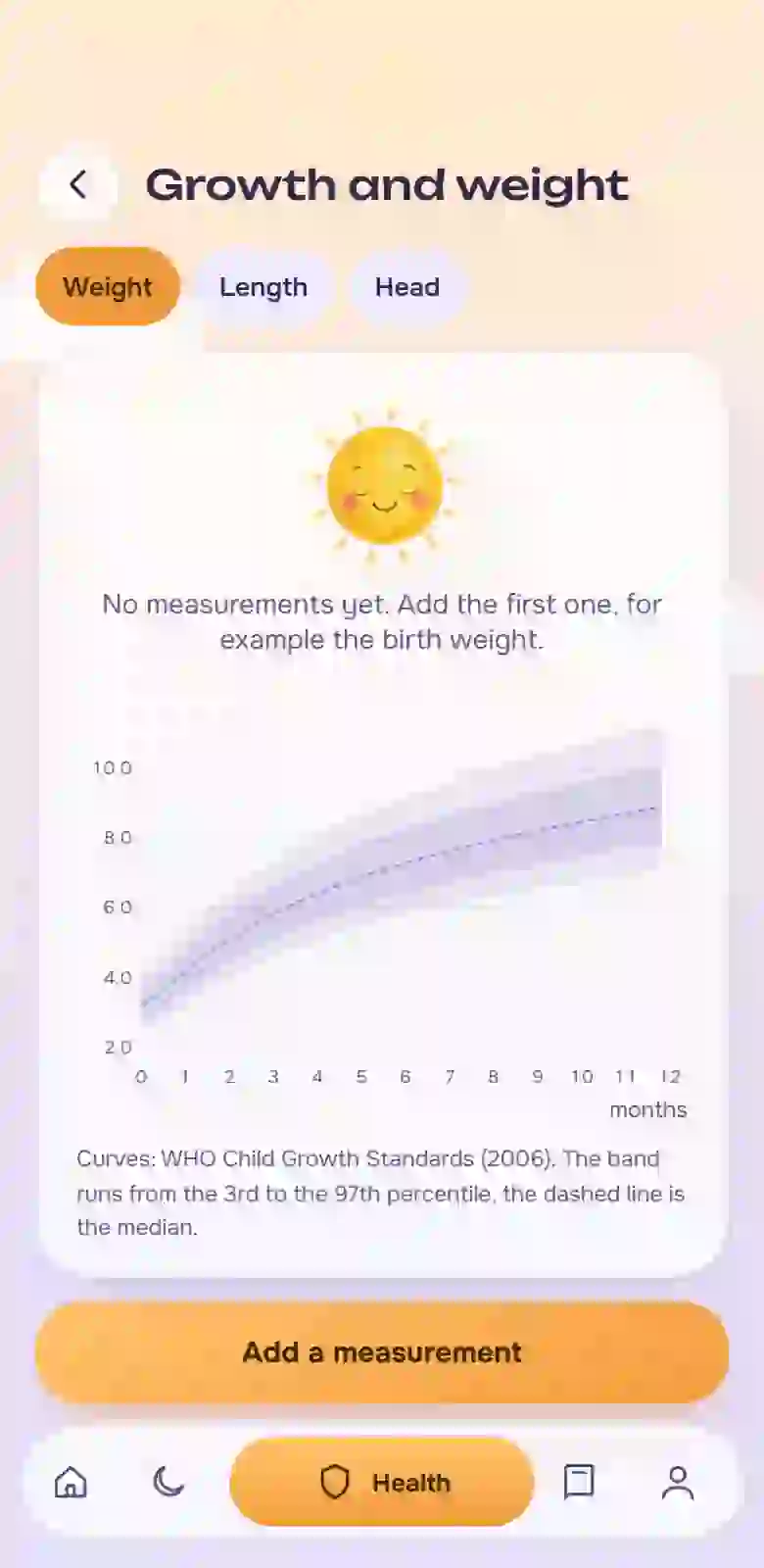
- The band is the range from the 3rd to the 97th percentile, where most children in the WHO sample are.
- The dashed line is the median, the 50th percentile.
- Look at length and weight together. A tall, slim child and a shorter, sturdier child can be equally healthy.
- One point decides nothing. Add a few measurements to see the curve.
The calculator doesn't grade results or color anything red. It helps you understand the numbers and prepare questions for your doctor.
Track the growth curve in Estrelu
In Estrelu's growth tracker, each measurement lands on curves based on WHO tables: a band from the 3rd to the 97th percentile and a dashed median. No "good" or "bad", no red. Entering the baby's sex is optional.
Everyone in the family sees the same measurements. Before a checkup, the doctor visit summary brings together growth, feeds and sleep, to show on screen, print or send as text.
When to talk to your doctor
Talk to your pediatrician if:
- the curve has crossed two percentile lines up or down (NHS);
- your baby isn't back to birth weight by 3 weeks (the NHS notes most babies are by then);
- weight has stopped going up or has gone down over several measurements;
- points fall outside the band from the 3rd to the 97th percentile;
- length and weight move in different directions, for example length up and weight down;
- the changes come with poor appetite, unusual sleepiness, frequent vomiting or diarrhea.
Get help the same day if your baby shows signs of dehydration: fewer wet diapers, a sunken soft spot on the head, drowsiness (NHS). That is not a percentile question, it is a reason for a checkup today. Call 911 in an emergency.
Estrelu is not a medical device. It does not diagnose, calculate doses or replace advice from your doctor. This calculator is for information only and does not assess your child's health.
Frequently asked questions
- What does the 25th percentile for weight mean?
- About 25% of children of the same age and sex in the WHO reference sample weigh less, and about 75% weigh more. A percentile shows where your child sits among peers, not whether the weight is good or bad.
- What is a normal percentile for a baby?
- There is no single right percentile. Healthy children grow along different percentiles. What matters more to your pediatrician is how the points line up over time and how your child is doing.
- How often should I weigh my baby?
- The NHS (UK) suggests that after the first 2 weeks, babies are weighed no more than once a month up to 6 months, once every 2 months from 6 to 12 months, and once every 3 months after their first birthday.
- Are WHO growth charts used in the US?
- Yes, for young children. The CDC and the AAP recommend the WHO growth charts for children from birth to 2 years in the US.
Sources
- WHO. Child growth standards who.int
- WHO. Questions and answers on the child growth standards (Spanish) who.int
- CDC. WHO growth charts cdc.gov
- CDC. Summary: Using WHO Child Growth Standards cdc.gov
- NHS. Your baby's weight and height nhs.uk
- NHS. Dehydration nhs.uk
- RCPCH: UK-WHO growth charts, 0–4 years rcpch.ac.uk
Try Estrelu
Five days free, no card asked.
Read next
- Baby Growth Tracker with WHO Growth ChartsPlot your baby's weight and length on WHO 2006 growth standard curves, with a 3rd to 97th percentile band and no red alarms or labels. Offline, in your browser.
- Baby Log for Pediatrician VisitsTurn 7, 14 or 30 days of feeds, sleep and diapers into a pediatrician summary, plus your question list and appointment reminders. Offline, in your browser.
- Baby Feeding Tracker: Log Breast, Bottle and Diapers in One TapLog breast, bottle and diapers in one tap with Estrelu, a baby feeding tracker that runs in your browser, works offline and supports oz. No app store, no ads.