 Estrelu
Baby jet lag and time change planner
This planner helps you shift your baby's sleep before a flight across time zones or a clock change at your destination. Enter the time difference and the date, and it suggests how many minutes a day to move wake-up, naps and bedtime. It works for babies and toddlers from birth to age three.
What you enter isn't sent anywhere and isn't saved.
Why time zones are hard on babies
Everyone has an internal clock, and it doesn't jump when the clock on the wall does. The CDC travel guide describes jet lag as a temporary mismatch between the body's internal clock and local time after rapid travel across time zones (CDC Yellow Book).
Your baby has no idea why it's suddenly bedtime when their body says it's mid-afternoon. That's where the fussiness, early wake-ups and night waking come from in the first days of a trip.
The idea: 10 to 15 minutes a day
The gentlest approach is to move the whole day a little at a time. A physician at Nationwide Children's Hospital suggests shifting a child's schedule by 10 to 15 minutes every night in the week before a time change (Nationwide Children's).
This is a practical approach, not a medical rule. It is easy to plan: one hour of difference takes 4 to 6 days. Move wake-up, naps and meals too, not just bedtime, so the day stays in sync.
| Time difference | 15-minute steps | 10-minute steps |
|---|---|---|
| 1 hour | 4 days | 6 days |
| 2 hours | 8 days | 12 days |
| 3+ hours | shift part of it before the trip, finish at the destination |
Flying east
Going east, local time is ahead, so your baby will need to sleep earlier than their body expects. New York to London is a good example: London is usually five hours ahead.
In the days before you leave, move wake-up, naps and bedtime earlier by 10 to 15 minutes a day. After you land, open the curtains in the morning and get outside. The CDC notes that bright morning light helps shift the body clock earlier, while evening light shifts it later (CDC Yellow Book). That research is in adults, but daylight and outdoor time are simple, safe helpers for babies too.
Flying west
Going west, local time is behind, so your baby will need to stay up later than usual. For adults this direction is usually easier: the CDC estimates adjustment at about 1.5 hours per day flying west versus about 1 hour per day flying east (CDC Yellow Book).
Move the schedule later by 10 to 15 minutes a day. At the destination, evening light helps: a walk before sunset, a bright room before the bedtime routine.
When the clocks change
A clock change is a one-hour shift, and you can prepare with the same steps.
- Clocks spring forward: for 4 to 6 days beforehand, move the schedule earlier by 10 to 15 minutes a day.
- Clocks fall back: move the schedule later by 10 to 15 minutes a day, so your baby doesn't start waking an hour early.
According to Nationwide Children's, it may take a few days, sometimes up to a week, for kids to fully adjust (Nationwide Children's).
Stick with the familiar steps—bathing, brushing teeth, reading, cuddling—even if the timing feels a little off. Predictable routines help signal to kids that it's time to wind down, regardless of the clock.
On travel day
Travel days rarely go to plan, and that's expected with a little one.
- Don't chase a perfect schedule. Let your baby sleep when tired: in the stroller, the carrier or your arms.
- Bring familiar things. A favorite toy, swaddle or sleep sack that smells like home can make a new room easier.
- Switch to local time on arrival. Meals, walks and bedtime follow the clock where you are.
For a short trip of two or three days, shifting may not be worth it. Many families keep home time and plan outings around their baby's usual rhythm.
What helps once you arrive
- Light by day, dark by night. Get outside in the daytime. Blackout curtains can help with early waking (Nationwide Children's).
- The same bedtime routine. Bath, book and song in the same order as at home.
- Naps on local time. Avoid very long naps that eat into the night.
- A safe sleep space. In a hotel or at a relative's home, the AAP advises placing babies on their back on a firm, flat surface without pillows or loose bedding (AAP).
How it works in Estrelu
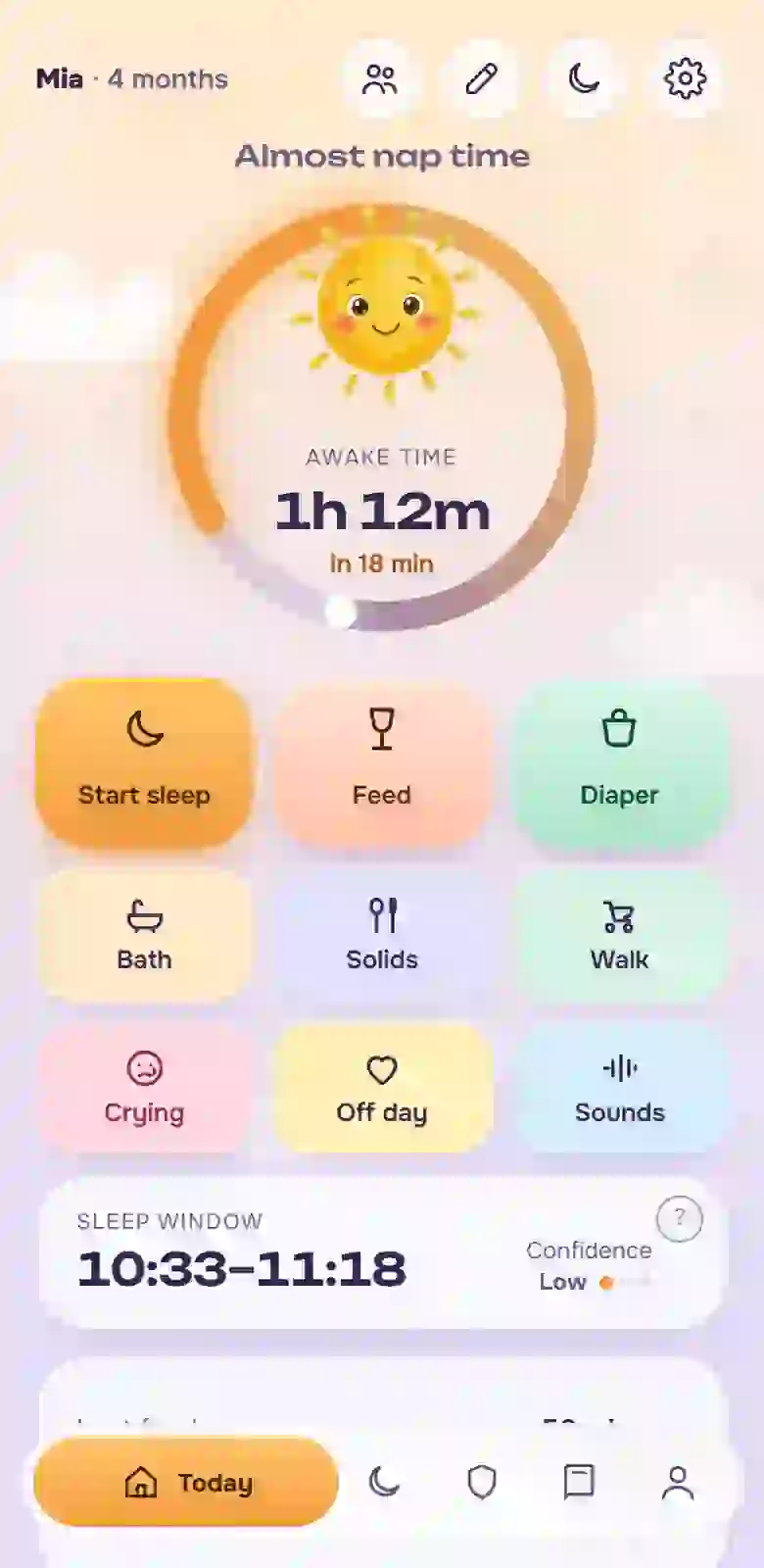
The "Clock change & travel" feature builds a step-by-step plan to shift your baby's sleep. Estrelu works offline after the first launch, so the plan, night screen and sounds work on the plane too.
After the trip, the nap forecast adapts to your new logs. If your baby gets sick while traveling, mark an "Off day": the forecast won't learn from it and will show a wider range. Learn more about the sleep tracker, or get a quick estimate with the wake window calculator.
When to call your doctor
Sleep that's off after a trip usually settles on its own. Call your pediatrician if:
- sleep hasn't settled one to two weeks after you get home;
- your baby is unusually floppy or hard to wake;
- there's fever, vomiting, diarrhea, or refusal to eat or drink;
- you see fewer wet diapers than usual.
Estrelu is not a medical device. It does not diagnose, calculate doses or replace advice from your doctor. This planner is for general information only.
Frequently asked questions
- How many days before a trip should I start shifting my baby's sleep?
- It depends on the time difference. Moving 10 to 15 minutes a day, one hour takes about 4 to 6 days. For bigger differences, many families shift part of the way before the trip and finish at the destination.
- How long does baby jet lag last?
- There is no solid data for babies. The CDC travel guide estimates that adults adjust about 1 hour per day after flying east and about 1.5 hours per day after flying west. Many young children need a few days, sometimes up to a week.
- Should I shift naps too, or just bedtime?
- Shift everything together: wake-up, naps, meals and bedtime. If only bedtime moves, the rest of the day stops lining up.
- Does Estrelu have a time change plan?
- Yes. The "Clock change & travel" feature builds a step-by-step plan to shift sleep. After the trip, the nap forecast adapts to your baby's new logs.
Sources
- Nationwide Children's Hospital. Helping Kids Adjust to the Time Change (2025) nationwidechildrens.org
- CDC Yellow Book 2026. Jet Lag Disorder ncbi.nlm.nih.gov
- AAP HealthyChildren. Safe Sleep healthychildren.org
Try Estrelu
Five days free, no card asked.
Read next
- Baby Sleep Tracker App with Nap PredictionEstrelu predicts your baby's next nap as a time range with a confidence level and plans today and tomorrow. Works offline in your browser, no app store, no ads.
- Wake window calculatorEnter your baby's birth date and wake-up time to see when the next nap may fit. Plus a wake window chart by age, newborn to 3, and where the numbers come from.
- Leap and Teething Tracker for Fussy WeeksMark teething, illness, leaps and shots as off days so the sleep forecast stays honest, and see when a fussy week may come. Works offline in your browser.
- Baby Log for Nanny and Caregiver HandoffsHand off to a nanny, partner or grandparent with one text: last feed, time awake and the next nap window. Estrelu runs in your browser, offline, with no ads.