 Estrelu
How to dress a baby for a winter walk
Dress your baby in several thin layers, with one more layer than you are wearing yourself — that's the AAP's rule of thumb. Add a hat, mittens and warm socks or booties. In the car seat, skip the puffy coat or snowsuit: buckle your baby in thin layers and put a blanket or coat over the straps. Check warmth on the chest or neck, not the hands.
How many layers does a baby need in winter?
Babies lose heat faster than adults. The AAP explains that children's smaller bodies lose heat more quickly, and the NHS adds that small babies are not very good at regulating their own temperature.
The simplest guide is to look at yourself. The AAP says infants should wear one more layer than adults: if you have a coat on, your baby will probably need a coat and a blanket. The NHS puts it the same way — 1 extra layer than what you're wearing — and adds a useful check: if you feel chilly, your baby probably does too.
Several thin layers beat one thick one. They keep kids warm and dry, and you can take one off when you walk into a warm shop.
What should a baby wear for a winter walk?
The AAP describes a layering order that works for the stroller and the car:
| Layer | What it can be |
|---|---|
| Base, close to the skin | Long-sleeved bodysuit, tights or leggings; long underwear in very cold weather |
| Middle | Pants and a warmer top, like a sweater or thermal-knit shirt |
| Top | A thin fleece jacket; outdoors in the stroller, a coat and blanket over it (one layer more than you) |
| Extras | Hat, mittens, warm socks or booties |
A few small things matter more than they look:
- Hat and mittens. The AAP calls boots, mittens or gloves and a hat essential for cold weather.
- Spare mittens. Wet mittens make your child colder rather than warmer, so keep an extra pair in the bag.
- Wet clothes come off right away. The AAP says children should change out of wet clothes immediately.
- Layers come off indoors. The NHS says to remove hats and extra clothing as soon as you're indoors or get into a warm car, bus or train — even if it means waking your baby.
If you're also wondering how to dress your baby for sleep once you're back home, see our guide to baby room temperature and night clothes.
How do you keep a baby warm in a car seat in winter?
This is where winter dressing and safety pull in opposite directions. The AAP is clear: bulky clothing, including winter coats and snowsuits, should not be worn under the harness. In a crash, the fluffy padding flattens, leaving space under the straps, and a child can slip through.
What the AAP suggests instead:
- Keep the infant carrier indoors when you're not using it, so it starts at room temperature.
- Dress your baby in thin layers, then take off the coat and blanket before buckling in.
- Tighten the harness. If you can pinch the strap at the chest, it needs to be tighter.
- Put warmth on top. Drape a blanket over the buckled harness, or put the coat on backwards over the straps. Make the top layer easy to remove so your baby doesn't get too hot once the car warms up.
- Nothing bulky underneath. Use a car seat cover only if it has no layer under the baby, and leave the face uncovered. The AAP warns never to use sleeping bag inserts or other stroller accessories in the car seat.
- Pack a car bag with extra blankets, dry clothes, hats and gloves.
When you arrive, the NHS advises taking your baby out of the car seat as soon as you get to where you're going.
How can you tell if your baby is too cold or too hot?
Hands and feet are a poor guide. The NHS says to check your baby's temperature by feeling their chest or the back of their neck; cool hands or feet on their own are normal.
- Too hot: sweating, or a tummy that feels hot to the touch. The NHS says to take off some clothing. This often happens after you step into a warm shop or bus with your baby still bundled up.
- Getting cold: the chest or neck feels cool. And remember the NHS check: if you feel chilly, your baby probably does too. Add a layer or head home.
Frostbite and hypothermia: warning signs
Frostbite is most likely on fingers, toes, ears and the nose. The AAP describes skin that may hurt or burn, then go numb, and turn white or pale gray, sometimes with blisters. The NHS notes frostbite is possible when skin is exposed to 0 °C (32 °F) or below.
What to do: bring your baby inside and warm the area gently. Don't rub it, don't pop blisters, and don't put anything hot directly on the skin. If pain or numbness lasts more than a few minutes, call your pediatrician. The NHS says to call emergency services for hard, frozen skin, swelling with loss of feeling, or blisters.
Hypothermia is a dangerous drop in body temperature. According to the NHS, a baby with hypothermia may be cold to touch, floppy, unusually quiet and sleepy, and may refuse to feed. The AAP calls hypothermia a medical emergency.
If you suspect it, call 911 (US) or 999 (UK) right away. While you wait, bring your baby indoors, remove wet clothing and wrap them in a blanket with the head covered. The NHS says not to use a hot bath, a hot water bottle or a heat lamp, and not to rub the arms and legs.
When is it better to stay home?
The AAP says playing outside in temperatures or wind chills below −15 °F (about −26 °C) should generally be avoided — at that point, exposed skin begins to freeze within minutes. Check the wind chill, not just the thermometer.
On milder days, the AAP still recommends reasonable time limits and regular breaks indoors to warm up. Head home early if your baby's clothes get wet. If your baby is unwell, was born early or you're unsure about a newborn, ask your pediatrician what's sensible before a long walk.
How to log winter walks and stroller naps in Estrelu
Many babies fall asleep in the stroller, and a nap outside still counts toward the day. Estrelu is a baby diary that runs in your phone's browser; you can add it to your home screen.
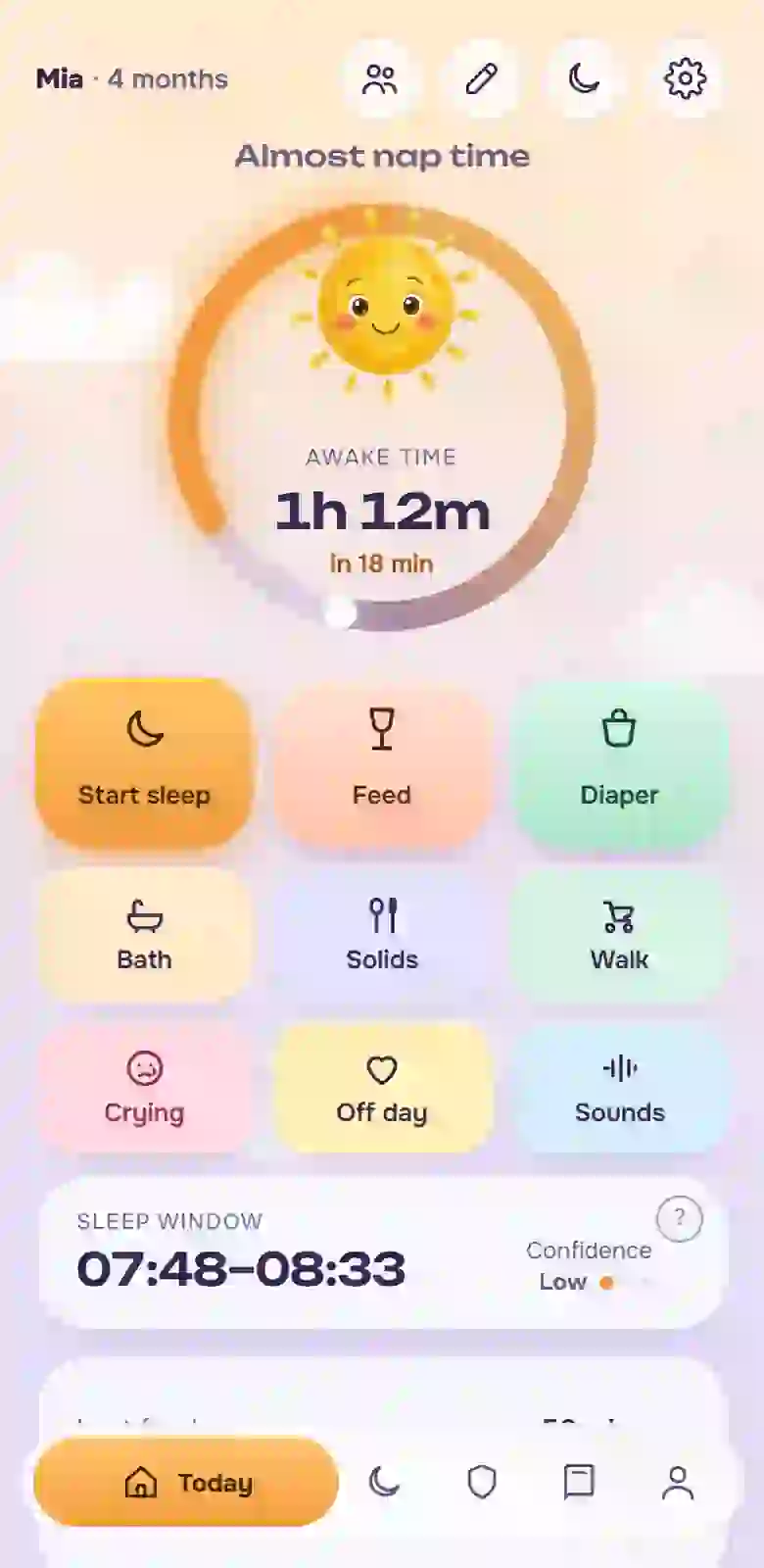
- One tap or a swipe. When your baby dozes off in the stroller, tap "Start sleep", swipe up on the night screen, or type a short phrase. It goes into the sleep tracker, and the next nap forecast takes it into account as a time range with a confidence level.
- No signal in the park. After the first open, Estrelu works offline, and entries sync when you're back online.
- Grandma walks the baby. In "Account and family", tap "Invite someone" and choose "Nanny or grandparent". The code works once, for 48 hours. She logs the stroller nap herself, and her name appears next to her entries.
- Handing over before a walk. The "Handoff summary" sends the last feed, time awake and the next sleep window as plain text through your phone's Share menu to any messenger. More in caregiver handoff.
- A sick day. If a cold knocks out your routine, mark it as an "Off day": the forecast won't learn from it. Temperatures and medicines go in the fever and medicine log.
To see how long your baby can comfortably stay awake before the next walk, try the wake window calculator. One subscription covers the whole family, and the 5-day trial needs no card.
Estrelu is a baby diary, not a medical device. It doesn't diagnose and doesn't replace your doctor. If you're worried about your baby, call your pediatrician, and in an emergency call emergency services.
Frequently asked questions
- How many layers should a baby wear outside in winter?
- The AAP's rule of thumb is one more layer than an adult would wear in the same weather. Several thin layers work better than one thick one, plus a hat, mittens and warm socks or booties.
- Can my baby wear a snowsuit in the car seat?
- No. The AAP says bulky clothing, including winter coats and snowsuits, should not go under the car seat harness. Buckle your baby in thin layers, then put a blanket or the coat over the straps.
- How do I know if my baby is too cold or too hot outside?
- Feel the chest, tummy or back of the neck rather than the hands, which are often cool. Sweating or a hot tummy means too warm; a baby who is cold to the touch, floppy or unusually quiet and sleepy needs help right away.
- What temperature is too cold to go outside with a baby?
- The AAP says outdoor play should generally be avoided when the temperature or wind chill is below −15 °F (about −26 °C), because exposed skin starts to freeze within minutes. Ask your pediatrician what is sensible for your baby.
- Should I wake my baby to take off layers after a walk?
- The NHS advises removing hats and extra clothing as soon as you come indoors or get into a warm car, bus or train, even if it means waking your baby.
Sources
- AAP / HealthyChildren.org, Winter Car Seat Safety Tips healthychildren.org
- AAP / HealthyChildren.org, Playing Outside in Winter: Tips to Keep Kids Warm & Safe healthychildren.org
- AAP / HealthyChildren.org, Cold Weather Safety for Children healthychildren.org
- NHS, How to dress a newborn baby nhs.uk
- NHS, Hypothermia nhs.uk
- NHS, Frostbite nhs.uk
- NHS, Sudden infant death syndrome (SIDS) nhs.uk
Try Estrelu
Five days free, no card asked.
Read next
- Baby room temperature for sleep: how warm, and what to wearIdeal baby room temperature for sleep (16–20 °C, about 61–68 °F), what to dress baby in for each range, and how to tell if they're too hot or too cold.
- Baby Log for Nanny and Caregiver HandoffsHand off to a nanny, partner or grandparent with one text: last feed, time awake and the next nap window. Estrelu runs in your browser, offline, with no ads.
- Baby Sleep Tracker App with Nap PredictionEstrelu predicts your baby's next nap as a time range with a confidence level and plans today and tomorrow. Works offline in your browser, no app store, no ads.
- Baby Medicine Tracker and Fever LogLog fever readings and medicine times, see when the next dose is allowed and get a warning before a possible double dose. Estrelu never calculates doses.