 Estrelu
Baby room temperature for sleep: how warm, and what to wear
Keep your baby's room cool: the NHS says a room temperature of 16 to 20 °C (about 61–68 °F) is comfortable and safe for sleeping babies. Dress them in layers — a sleepsuit plus a well-fitting sleeping bag or a firmly tucked-in light blanket — and skip the hat indoors. To check whether they're too warm, feel the chest or the back of the neck, not the hands.
What temperature should a baby's room be?
Once the heating goes on, it's easy to end up with a nursery that feels cozy to you and too warm for a baby. Health bodies in different countries give slightly different numbers, but they all point the same way: cool, not warm.
| Country | Recommended room temperature for baby's sleep | Source |
|---|---|---|
| UK | 16–20 °C (about 61–68 °F) | NHS, The Lullaby Trust |
| Germany | 16–18 °C (about 61–64 °F) | Berlin Senate health department, 2024 |
| France | 18–19 °C (about 64–66 °F) | CHU de Rouen |
| USA | "A comfortable temperature" — no exact number | AAP / HealthyChildren.org |
The common thread: a cool room, layers of clothing instead of piles of bedding, no hat, and checking your baby's neck or chest. The Lullaby Trust notes that 16–20 °C feels chilly to many adults, so don't go by feel. Don't guess — keep a room thermometer where your baby sleeps, not by the door or next to the radiator.
How to dress baby for sleep at different temperatures
The NHS describes the basic night outfit as a sleepsuit plus either a sleeping bag, or a sheet and/or blanket. The Lullaby Trust breaks it down by room temperature:
| Room temperature | What your baby can wear |
|---|---|
| Below 16 °C (below about 61 °F) | Add a layer of clothing or choose a warmer sleeping bag (higher tog) |
| 16–20 °C (about 61–68 °F) | A sleepsuit and a firmly tucked-in light blanket — or a sleepsuit in a well-fitting sleeping bag |
| Above 20 °C (above 68 °F) or a heatwave | A light layer: a short-sleeved bodysuit, or even just a diaper |
A few details make the difference:
- Sleeping bag fit. A baby sleeping bag should fit well, especially around the neck and arms. The AAP also mentions a wearable blanket in the right size that doesn't cover the head.
- Blankets. Light sheets or blankets should be tucked in firmly with no loose ends. A blanket folded in half is twice as warm — count it as two layers.
- How many layers. The AAP's rule of thumb: no more than one layer more than you'd wear yourself, and layers of clothing are safer than blankets. The NHS gives the same guide for daytime: one more layer than an adult.
Going out in the cold? See how to dress your baby for a winter walk — layers, the car seat and the signs of being too cold.
How to tell if your baby is too hot or too cold
Hands and feet are a poor guide. The Lullaby Trust says to check the chest or the back of the neck; hands and feet are usually cooler, and that's normal.
- Too hot: sweating, or the tummy or chest feels hot. The NHS says to remove some clothing or bedding; the AAP also names sweating or a hot chest as signs a baby may be too warm.
- Too cold: if your baby is in a sleeping bag and seems cold, the NHS suggests adding a layer of clothing underneath — not a blanket on top.
- Cool hands and feet: normal on their own.
Why no hat? According to the Berlin health department, a dressed baby gives off heat mainly through the uncovered head.
What not to do
- Hats and mittens for sleep. The Lullaby Trust says no — including for premature babies who wore them on the unit. The AAP says no hat indoors except in the first hours after birth or in the NICU.
- Duvets, quilts and pillows under one year. The Lullaby Trust advises none of these before your baby's first birthday. The Berlin flyer warns that blankets, pillows and fur raise the risk of your baby getting covered and overheating.
- A blanket over a sleeping bag. Don't add one; the bag already helps stop your baby from slipping down under covers.
- Heavy blankets or heavy clothing, per the AAP.
- Staying bundled up indoors. Take off hats and extra layers as soon as you come inside or get into a warm car, bus or train. On long car trips, CHU de Rouen advises no snowsuit and not overheating the car.
- Wrapping up a sick baby. See below.
If your baby is unwell
The Lullaby Trust explains that a fever is usually 38 °C (100.4 °F) or higher, and a baby who is unwell needs fewer layers, not more. If your baby is under 3 months old and has a temperature of 38 °C (100.4 °F) or higher, get medical help. If your baby seems seriously ill, call 911 in the US or 999 in the UK.
How room temperature connects to sleep — and where Estrelu helps
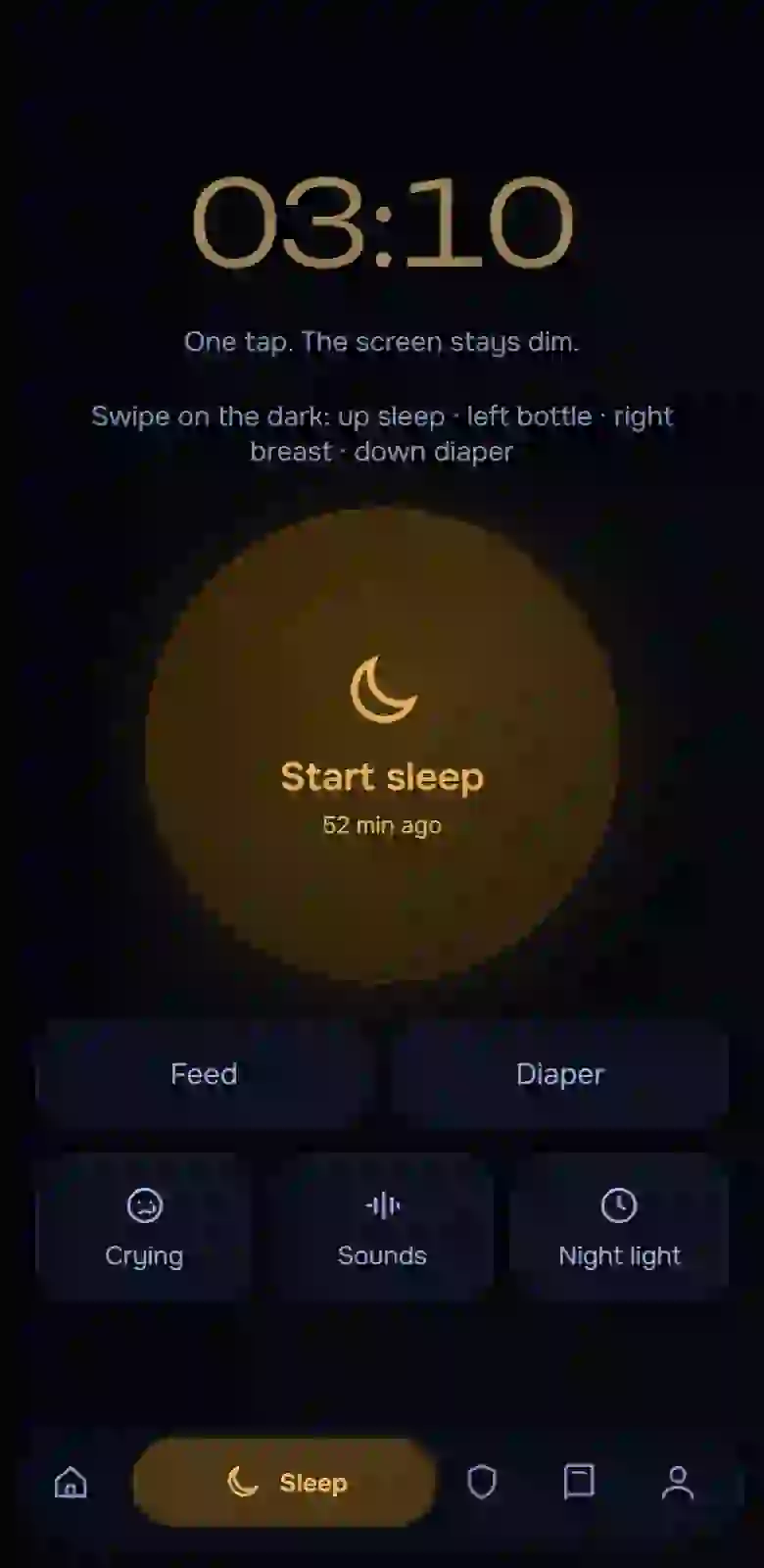
A room that's too warm and too many layers are among the things the sources above warn about, and small changes are easier to judge when you can look back at real nights instead of tired memories. Estrelu is a baby tracker that runs in your phone's browser and can be added to your home screen.
- Sleep log. Record naps and nights in the sleep tracker. If you lower the heating or change your baby's layers, keep logging for a few nights and look back at how sleep went.
- Offline at night. After the first open, logging, the night screen and the sounds work without internet. On the night screen you swipe up for sleep, left for a bottle, right for breastfeeding and down for a diaper, so you don't need bright menus at 3 a.m.
- White noise. The white noise and bedtime sounds play offline too.
- "Off day" for illness. Mark sick days (or teething, a leap, a vaccination) as an Off day, and the nap prediction won't learn from those days. Fever readings and medicines go in the fever and medicine log.
- Wake windows. Check how long your baby can comfortably stay awake with the wake window calculator.
One subscription covers the whole family. The trial is 5 days and we don't ask for a card.
Estrelu is not a medical device. It doesn't diagnose, calculate medicine doses or replace your doctor.
Moving from two naps to one? Follow the 2 to 1 nap transition plan.
Frequently asked questions
- What temperature should a newborn's room be at night?
- The NHS and The Lullaby Trust say 16 to 20 °C (about 61–68 °F) is comfortable and safe for sleeping babies. Germany's Berlin health department gives 16–18 °C and CHU de Rouen in France 18–19 °C. The AAP in the US says a comfortable temperature, without a number. Use a room thermometer where your baby sleeps rather than guessing.
- Should my baby wear a hat to sleep?
- No. The Lullaby Trust says no hats or mittens for sleep, including for premature babies who wore them in hospital. The AAP says no hat indoors except in the first hours after birth or in a neonatal intensive care unit.
- How do I know if my baby is cold at night?
- Feel your baby's chest or the back of the neck. Cool hands and feet are normal. If your baby is in a sleeping bag and feels cold, the NHS suggests adding a layer of clothing under it.
- Can I put a blanket over a sleeping bag?
- No. The Lullaby Trust advises not to add a blanket on top of a baby sleeping bag. The bag itself helps stop your baby from slipping down under covers.
- How many layers should a baby wear to sleep?
- The AAP says no more than one layer more than you would wear yourself. In a 16–20 °C room, The Lullaby Trust suggests a sleepsuit plus a firmly tucked-in light blanket, or a sleepsuit in a well-fitting sleeping bag.
Sources
- NHS Start for Life — How to dress a newborn nhs.uk
- The Lullaby Trust — Easy Read card: How to dress baby for sleep (October 2025) lullabytrust.org.uk
- The Lullaby Trust — Temperature fact sheet (hosted by WWL NHS Foundation Trust) wwl.nhs.uk
- AAP / HealthyChildren.org — 9 ways to reduce the risk of SIDS (Spanish edition, updated 13 January 2026) healthychildren.org
- Berlin Senate Department for Health — Babyschlaf flyer (August 2024) berlin.de
- CHU de Rouen — Prévention de la mort inattendue du nourrisson chu-rouen.fr
Try Estrelu
Five days free, no card asked.
Read next
- How to dress a baby for a winter walkHow to dress a baby for winter walks: thin layers, one more than you, no puffy coat under car seat straps, signs of cold or overheating, when to stay in.
- Baby Sleep Tracker App with Nap PredictionEstrelu predicts your baby's next nap as a time range with a confidence level and plans today and tomorrow. Works offline in your browser, no app store, no ads.
- White Noise App for Baby That Works OfflineSeven white noise sounds with a timer that play without internet, plus a cry timer, colic notes, a bedtime routine and a night-light clock. No ads.
- Baby Medicine Tracker and Fever LogLog fever readings and medicine times, see when the next dose is allowed and get a warning before a possible double dose. Estrelu never calculates doses.