 Estrelu
Questions to ask your pediatrician, checkup by checkup
Bring a week of notes on feeds, sleep and wet and dirty diapers, plus your questions written down in order of importance. If you only get to ask three, make them these: "Is my baby gaining weight well?", "Is there anything about development you want us to watch?" and "When should I call you, and how do I reach you after hours?"
How to prepare in 5 minutes before the visit
Checkups go fast, and it's easy to forget the one thing you meant to ask. The American Academy of Pediatrics suggests writing down what you want to discuss, choosing your top three to five questions and raising them at the start of the visit, not at the end. A quick routine that works:
- Notes for the last week. How many feeds a day, roughly how long your baby sleeps at night and in the day, how many wet and dirty diapers. Totals and patterns matter more than every single entry.
- Photos and short videos. A rash that comes and goes, a strange breathing sound, a jerky movement in sleep. A 10-second clip shows the doctor more than a description.
- Medicines and vitamins. Everything your baby takes, with the name as written on the box. Add anything new since the last visit.
- Questions, sorted. Put the one that keeps you up at night first. Write the rest below it and tick them off during the visit.
- Your own notes from last time. If the doctor asked you to watch something, bring what you saw.
Questions by age
The AAP schedule lists checkups in the first week (3 to 5 days old) and at 1, 2, 4, 6, 9 and 12 months. In the UK, health visitors offer a new birth review at 1 to 14 days, a review at 6 to 8 weeks and a review between 9 and 15 months. Your own schedule may differ, so use the rows below for the closest visit.
| Visit | Feeding and weight | Diapers and sleep | Vaccines and development |
|---|---|---|---|
| First week | Is my baby getting enough milk? Is this weight loss normal, and when should birth weight be back? | How many wet diapers should we see now? Is our sleep setup safe? | Has the newborn screening been done? What's the next step on our vaccine schedule? |
| 1–2 months | Is weight gain on track? How often should my baby feed now? Is spitting up this much OK? | Is this stool color normal? How long can I let my baby sleep at night without a feed? | What vaccines are due on our schedule? CDC's 2-month list includes holding the head up on the tummy and smiling when you talk. Should I worry if mine doesn't yet? |
| 4 months | Is the growth curve steady? Is it too early to think about solids? | Night waking has started again. Is that normal at this age? | What's next on the vaccine schedule? The 4-month checklist includes pushing up onto elbows on the tummy and cooing. How do we practise tummy time? |
| 6 months | Is my baby ready for solids? Which foods first, and how do we introduce allergens? | How many naps a day is typical now? Is our crib still safe now that my baby rolls? | Which vaccines are due? CDC lists rolling from tummy to back at this age. Anything you want us to watch? |
| 9–12 months | How much milk alongside meals? When can we move to a cup? | Is it normal to drop to two naps or fewer? | What's left on the first-year schedule? AAP recommends general developmental screening at 9 months. Is my baby on track for sitting, pulling up and first words? |
CDC also suggests asking at every visit whether your baby has lost any skills they once had, and bringing its milestone checklist with you. If you or the doctor are still concerned, ask for a referral and about developmental screening.
Questions to ask at any age
These don't change with age, and the answers are easy to forget, so write them in your phone:
- "What temperature should make me call you, and at what age does that change?"
- "How do I reach you at night and on weekends? Is there a nurse line?"
- "Which symptoms mean we should go straight to the emergency room?"
- "Which fever medicine is safe for my baby, and how much should I give?" Ask the doctor or pharmacist rather than guessing.
- "When is our next visit, and what will you check then?"
- "Is there anything you'd like me to track before then?"
When not to wait for the checkup
Some things can't wait for the next appointment. Call your pediatrician straight away if:
- a baby younger than 3 months (12 weeks) has a temperature of 100.4°F (38.0°C) or higher;
- your baby looks very ill, is unusually drowsy or is very fussy, or has repeated vomiting or diarrhea.
Call 911 in the US or 999 in the UK if your baby is breathing very fast or struggling to breathe, has blue, grey or blotchy skin or lips, has a rash that doesn't fade when you press it, is having a seizure, is difficult to wake, or hasn't had a pee in the past 12 hours. If you feel something is seriously wrong, trust that and get help, even if the signs don't match the list.
How Estrelu helps you prepare
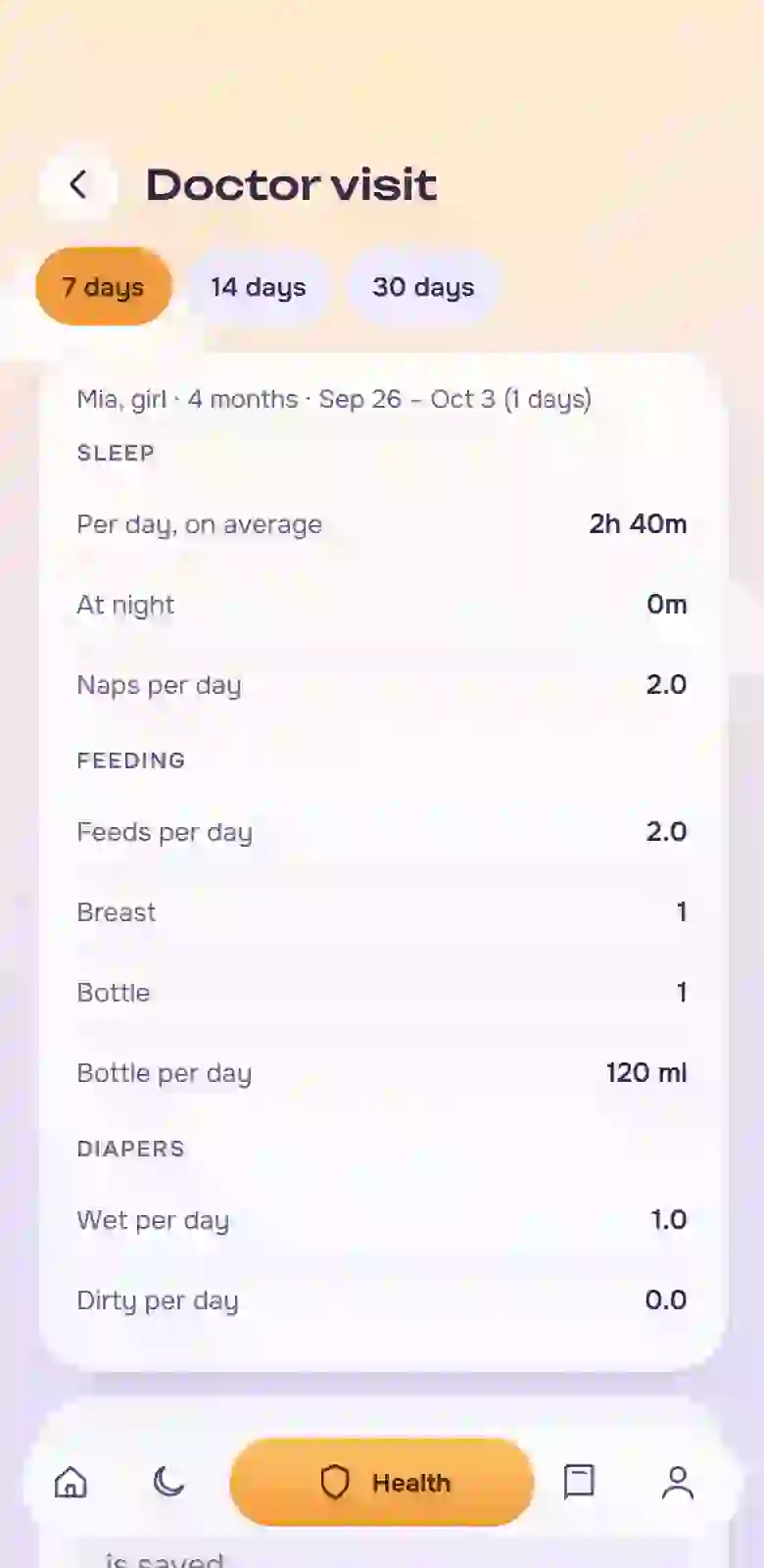
Estrelu is a baby tracker that runs in your phone's browser. When you log feeds, sleep and diapers through the week, the doctor's questions ("How many wet diapers a day?", "How long does she sleep at night?") already have answers.
- Doctor visit summary for 7, 14 or 30 days. Show it on your screen during the visit, print it, or send it as text. See the doctor visit summary.
- A question list you build between visits. Add a question the moment it comes to mind, and it is waiting next to the summary at the checkup.
- Off days. Mark a vaccination day, an illness or teething as an Off day, and the nap forecast won't learn from those days.
- Quick logging at night. On the night screen, swipe up for sleep, left for a bottle, right for breastfeeding and down for a diaper. You can also type a phrase like "fed left side at 2:20 pm".
- Works offline after the first open, so the waiting room's weak signal doesn't matter.
- One plan for the family. Every adult can log, with up to 4 babies. Five days free, no card needed.
Estrelu is not a medical device. It doesn't diagnose, calculate medicine doses or replace your doctor.
Frequently asked questions
- What should I bring to my baby's checkup?
- A week of notes on feeds, sleep and wet and dirty diapers, photos or short videos of anything that worried you, a list of any medicines or vitamins your baby takes, and your three to five most important questions written down.
- What should I ask at the 2-month checkup?
- Ask whether your baby's weight gain is on track, how many feeds a day is normal at this age, whether your sleep setup is safe, which vaccines come next on your country's schedule, and whether the doctor has any concerns about development. CDC's 2-month checklist includes holding the head up on the tummy and smiling when you talk.
- How many questions can I ask at a well-child visit?
- There's no fixed number, but the American Academy of Pediatrics suggests choosing your top three to five questions and raising them at the start of the visit, so the most important ones get answered first.
- When should I call the doctor instead of waiting for the checkup?
- Call straight away if a baby younger than 3 months has a temperature of 100.4°F (38.0°C) or higher, if your baby looks very ill, is unusually drowsy or very fussy, or if anything else worries you. For trouble breathing, a seizure or a baby you can't wake, call 911 in the US or 999 in the UK.
Sources
- HealthyChildren.org (AAP): Well-Child Care: A Check-Up for Success healthychildren.org
- HealthyChildren.org (AAP): Fever, When to Call the Pediatrician healthychildren.org
- CDC Learn the Signs. Act Early.: Milestones by 2 Months cdc.gov
- CDC: Developmental Milestones (checklist ages and screening) cdc.gov
- CDC: Milestone checklists, 2 months to 5 years (PDF) cdc.gov
- NHS: Is your baby or toddler seriously ill? nhs.uk
- GOV.UK: Delivery of the Healthy Child Programme, Part 2: health visiting ages 0 to 5 gov.uk
Try Estrelu
Five days free, no card asked.
Read next
- Baby Log for Pediatrician VisitsTurn 7, 14 or 30 days of feeds, sleep and diapers into a pediatrician summary, plus your question list and appointment reminders. Offline, in your browser.
- How many wet diapers should a newborn have? A day-by-day guideHow many wet and dirty diapers a newborn has by day of life, how they show your baby gets enough milk, and when to call the doctor. NHS and HSE data.
- WHO growth percentile calculator for babies and toddlersFree WHO growth chart calculator: your baby's weight, length and head circumference percentiles from birth to age 5, and how to read the curve.
- Baby Medicine Tracker and Fever LogLog fever readings and medicine times, see when the next dose is allowed and get a warning before a possible double dose. Estrelu never calculates doses.